Best Free Maze Generators Compared (2026): 4 Tools Tested
We tested 4 free maze generators — MazeGenerator.net, Discovery Education, Teacher's Corner, JigsawMake — on shapes, difficulty, PDF export and worksheets.
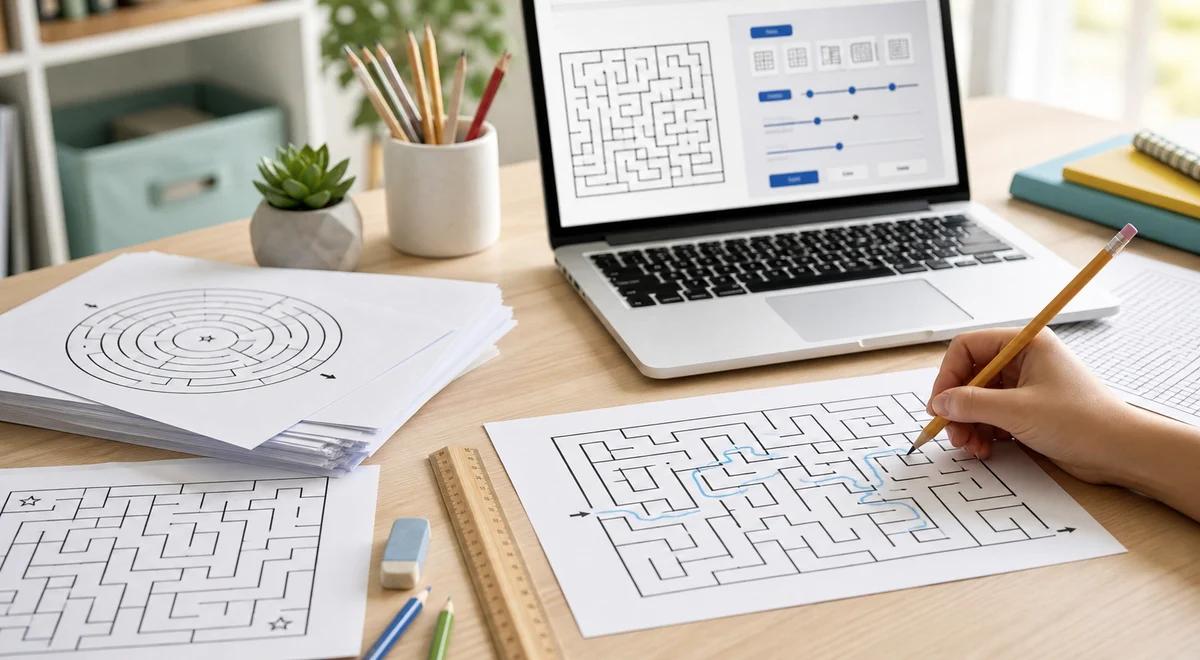
Maze Generator Comparison: 4 Free Tools Tested
We compared the four maze makers people actually use. Every row below was verified against each tool's live site or source code — a dash means we could not confirm that feature and would rather leave it blank than guess.
| Tool | Shape Options | Difficulty Control | PDF Export | Answer Key | Free-Tier Limit |
|---|---|---|---|---|---|
| MazeGenerator.net | Rectangular, circular, triangular, hexagonal | Grid up to 200x200 cells, plus advanced algorithm bias settings | Yes — PDF, SVG, or PNG | — | Free for personal use; commercial use requires a paid license |
| Discovery Education Puzzlemaker | Rectangle, cut-out, circle, wheel, escape | Grid up to 100x100 cells, plus 6 fill-style path patterns | — | — | Free, no signup required |
| Teacher's Corner Maze Maker | Rectangular; custom image shapes are a premium-only option | 6 lane-width presets (Easy to Very Hard), plus solution path length | Via browser "Print to PDF" (no native download button) | Click-to-reveal solution on screen, not a separate file | 10 lines with an ad blocker on, 30 lines free without one, 50 lines needs a premium subscription |
| JigsawMake (Maze Generator, Impossible Maze Generator, Printable Maze Generator) | Rectangular grid, adjustable up to 200x200 cells | 5 difficulty presets (Kids to Impossible), plus 3 algorithms (Backtracker, Prim, Kruskal) | Yes — free PDF; SVG export also free for commercial use; up to 100 pages per batch, 1-4 mazes per page | Yes — separate downloadable answer key PDF | Free, no signup, no watermark, no paywall |
Which Maze Generator Should You Pick
For a quick classroom worksheet, start with our free maze generator and print straight to PDF. Need something harder for older students? The impossible maze generator pushes difficulty well past standard tools. For batch worksheets with a custom title field for the whole class set, the printable maze generator is built for exactly that.
A well-designed maze worksheet does something most worksheets cannot: it turns seat work into a genuine problem-solving challenge. Students lean in, plan ahead, backtrack, and try again—all without realizing they are building critical thinking skills. Whether you teach kindergartners tracing their first paths or high schoolers who need a brain-stretching warm-up, a printable maze worksheet can fit into any lesson plan in minutes.
This guide walks you through how to create maze worksheets from scratch using a free Maze Generator, how to match difficulty to age groups, and creative ways to connect mazes to core subjects like math, science, and geography.
Why Maze Worksheets Engage Students
Research on game-based learning consistently shows that students retain information better when they are actively making decisions rather than passively receiving content. Maze puzzles create exactly that dynamic. Every junction is a low-stakes decision point, and every wrong turn is immediate feedback without judgment.
From a cognitive standpoint, maze navigation activates spatial reasoning, working memory, and planning—the same executive functions that underpin reading comprehension and mathematical problem-solving. That is why occupational therapists have used mazes as therapeutic tools for decades, and why educators from pre-K through high school reach for maze worksheets when they need an activity that genuinely holds attention.
- Fine motor development: Tracing a path builds pencil control in early learners.
- Persistence practice: Dead ends teach students to backtrack and try again—a skill that transfers to every subject.
- Low-anxiety assessment: A maze does not feel like a test, so even anxious students engage freely.
- Differentiation-friendly: Print the same theme at three difficulty levels and distribute by readiness in the same classroom.
Types of Maze Puzzles for Education
Not all mazes are created equal. The shape of the maze grid changes both the visual experience and the cognitive challenge. Understanding the three main types helps you choose the right format for your students and your learning objectives.
Rectangular Mazes
The classic grid layout. Paths run horizontally and vertically, making it the most intuitive format for young learners and the easiest to read when printed. Rectangular mazes scale cleanly from a tiny 5x5 beginner grid all the way up to sprawling 30x30 expert challenges. They also work best when you want to overlay academic content at intersections (more on that in the subject-integration section below).
Circular Mazes
Concentric ring mazes look visually striking on a worksheet and immediately signal to students that something different is happening today. Paths radiate outward from a center point, which forces students to think in curves rather than straight lines. Circular mazes are excellent for bulletin board displays, early-finisher challenges, and activities where you want the worksheet itself to create a conversation.
Hexagonal Mazes
Hexagonal grids give each cell six possible exits instead of four, which dramatically increases branching complexity. A moderately sized hex maze can feel significantly harder than a rectangular maze of the same dimensions. This makes hex mazes a strong choice for gifted learners, middle school enrichment, and any situation where you want a genuine challenge without simply scaling up the grid size.
How to Create a Maze Worksheet Step by Step
Creating a print-ready maze worksheet takes less than two minutes with the right tool. Here is the complete process using the free Printable Maze Generator.
Step 1: Choose Your Maze Shape
Open the generator and select a shape: rectangular, circular, or hexagonal. For most classroom uses, rectangular is the safest default. If you want to add visual variety or create a themed activity, try circular for a nature or astronomy unit.
Step 2: Set the Grid Size
Grid size controls how long students spend on the maze and how fine the pencil work needs to be. Smaller grids (5x5 to 8x8) print with wide corridors that young hands can navigate easily. Larger grids (20x20 to 30x30) print tighter paths suited to older students. Match the size to the time slot you have: a 10x10 maze typically takes 3 to 7 minutes for the target age group.
Step 3: Select a Difficulty Level
Difficulty controls how many dead ends and false paths the algorithm generates. Easy mazes have fewer branches and a more direct solution path. Hard mazes create dense networks of dead ends. The Impossible Maze Generator pushes this to the extreme—ideal for a challenge corner or a fun end-of-term competition.
Step 4: Generate and Preview
Click Generate to create a randomized maze. Every click produces a unique layout, so you can generate multiple versions for the same class and avoid students copying each other's solutions. Preview the solution path before printing to confirm the maze is solvable and appropriately challenging.
Step 5: Download and Print
Download your maze as a print-ready PDF. The file includes the blank puzzle sheet for students and a separate answer key for the teacher. Standard letter (8.5″ × 11″) and A4 formats both print cleanly without additional scaling.
Maze Activities by Age Group
Matching maze complexity to developmental stage is the single most important factor in whether the activity succeeds or frustrates. The table below gives you a practical starting point.
Pre-K and Kindergarten (Ages 3–6)
Use a 4x4 or 5x5 rectangular maze printed at maximum size. The goal at this age is not speed—it is hand-eye coordination and directional language (“turn left,” “go straight”). Laminate the sheet and let students use dry-erase markers so they can retry without wasting paper.
Grades 1–3 (Ages 6–9)
An 8x8 to 12x12 rectangular maze on Easy or Medium difficulty is the sweet spot. Students can handle meaningful dead ends and will feel genuine satisfaction on completion. This is also the right age to introduce themed mazes: a Halloween maze in October or a spring garden maze in April adds seasonal engagement without changing the core activity.
Grades 4–6 (Ages 9–12)
Move to a 15x15 or 20x20 grid on Medium or Hard difficulty. At this stage, mazes work well as timed warm-up activities (5 minutes at the start of class) or as fast-finisher tasks. You can also begin layering subject content at intersections—see the next section for specific ideas.
Grades 7–12 (Ages 12–18)
Hard and Impossible difficulty levels on large grids (25x25 or hexagonal) provide a genuine cognitive workout for older students. Use them as bell-ringers, logic warm-ups, or competitive activities where the first student to solve the maze wins a small reward. For advanced students, try the Impossible Maze Generator as a bonus challenge or extra-credit option.
Using Mazes Across Subjects: Math, Science, and Geography
A blank maze is a framework. What you write on it transforms it into a subject-specific learning activity. Here are three proven approaches that teachers use across grade levels.
Math Mazes
Print a rectangular maze and write a math equation at each intersection. Students may only travel through an intersection if they can solve the equation correctly—wrong answers lead down dead-end paths by design. This works for addition and subtraction in grades 1 and 2, multiplication and division in grades 3 through 5, and order of operations or algebraic expressions in middle school.
- Write equations on the paths between junctions, not at the junctions themselves, so students decide which path to take before they commit.
- Color-code correct-answer paths in the answer key to make grading instant.
- Use this format for fact fluency drills—students get immediate feedback because the wrong answer sends them into a dead end.
Science Mazes: Follow the Food Chain
Label maze corridors with organisms and tell students they may only travel from prey to predator (or producer to consumer, depending on the concept you are teaching). The correct path through the maze mirrors the correct ecological sequence. This approach works for food webs, the water cycle, the rock cycle, and any process that has a defined sequence of steps.
Geography Mazes: Trace the Route
Overlay a maze grid on a simplified map outline of a continent or country. Label key cities, capitals, or geographic features at specific junctions. Students must navigate from one capital to another using only valid geographic connections. This reinforces map reading, cardinal directions, and place-name recognition simultaneously.
Printable Maze Difficulty Levels Explained
The Printable Maze Generator offers four distinct difficulty settings. Understanding what each one changes helps you build a differentiated set of worksheets from a single planning session.
- Easy: The algorithm creates a single clear solution path with minimal branching. Dead ends are shallow and infrequent. Students who get stuck are never more than two or three steps from finding their way back on track. Best for early elementary and introduction activities.
- Medium: More branching paths and longer dead ends. Students will need to backtrack meaningfully at least two or three times on average. The maze still has a single solution, but finding it requires deliberate strategy. Best for upper elementary and review activities.
- Hard: Dense dead-end networks where nearly every path looks plausible for several steps before terminating. Solving requires systematic elimination. Best for middle school enrichment, timed competitions, and gifted learners.
- Impossible: Maximum algorithmic complexity. The solution path is valid but extraordinarily difficult to locate among the hundreds of false routes. Best used as an optional challenge, a class competition, or a motivational tool (“Can anyone solve the impossible maze?”). See the dedicated Impossible Maze Generator for these extreme challenges.
Tips for Designing Effective Maze Worksheets
Generating a maze takes seconds. Designing a maze worksheet that achieves a specific learning outcome takes a little more thought. These practical tips will help you get maximum value from every printout.
Add a Learning Objective to the Header
Print a short sentence above the maze that tells students what skill they are practicing. “Navigate the maze using only correct multiplication facts” or “Follow the food chain from producer to apex predator” frames the activity as learning, not just play, which matters for accountability and parent communication.
Include a Reflection Prompt Below the Maze
Leave two or three lines beneath the maze for a quick written reflection: “What strategy did you use when you hit a dead end?” or “Name one organism you passed through on your food-chain path.” This converts a purely visual activity into one that touches writing and metacognition standards.
Generate Multiple Versions for the Same Class
Because the generator creates a new randomized layout every time, you can print four or five completely different mazes at the same difficulty level and distribute them across student groups. Students at the same table cannot copy each other's solutions, which encourages genuine independent problem-solving.
Create a Differentiated Packet
Generate the same theme (the same subject-content overlay) at three difficulty levels—Easy, Medium, and Hard—and staple them together as a choice board. Students self-select their entry point, and you can observe which level each student chooses as informal assessment data.
Pair Mazes with Other Printable Puzzles
Maze worksheets pair naturally with other puzzle types. A crossword reinforces vocabulary, a word search builds pattern recognition, and a sudoku develops logical reasoning—all of which complement the spatial and planning skills that maze activities build. The Crossword Maker for Teachers, Word Search Maker for Teachers, and Sudoku for Kids are all free tools that let you build a complete printable puzzle packet in a single planning session. For a broader overview, see our guide to printable puzzles for the classroom.
Frequently Asked Questions
What is a maze worksheet?
A maze worksheet is a printable activity sheet featuring a maze puzzle that students navigate from a start point to a finish. Maze worksheets are used in classrooms, homeschool settings, and therapy programs to build problem-solving skills, fine motor control, and spatial reasoning.
How do I create a printable maze worksheet for free?
Use the free Printable Maze Generator on JigsawMake. Choose your maze size, difficulty level, and shape, then click Generate. Download the result as a print-ready PDF with an optional answer key. No account or software is required.
What maze difficulty level is right for my students?
For kindergarten and grades 1–2, choose a small 5x5 or 8x8 grid on Easy difficulty. Grades 3–5 work well with a 12x12 Medium maze. Middle and high school students can handle 20x20 or larger grids on Hard or the Impossible setting. Match the maze size to the time you want students to spend on the activity.
Can I use maze worksheets across different subjects?
Yes. In math class, label intersections with equations so students must solve them to find the correct path. In geography, overlay a maze on a map outline so students trace a route through countries or states. In science, design a food-chain maze where students follow the correct predator–prey path to the exit.
What shapes are available in the maze generator?
The Maze Generator uses a rectangular grid only — there is no circular or hexagonal shape option. Instead, you control the challenge through grid size and difficulty: pick a small grid for younger students, a large one for advanced students, or switch to the impossible maze generator for the hardest layouts.
How many maze worksheets can I generate?
There is no limit. Every click of the Generate button creates a unique, randomized maze so you can produce as many distinct worksheets as you need—print individual copies, create differentiated sets at different difficulty levels, or build a full maze packet for an entire class.
Do the maze worksheets include an answer key?
Yes. After generating a maze you can toggle the solution view to reveal the correct path, then download a separate answer key PDF. This makes grading fast and lets students self-check their work.
Are maze worksheets effective for students with learning differences?
Maze activities are widely used in occupational therapy and special education because they build fine motor skills, visual tracking, and executive function without requiring reading or writing. For students with dyslexia or processing differences, maze worksheets can be a low-stress alternative to text-heavy review activities.
What is the best free maze generator?
It depends on the job: MazeGenerator.net offers many geometric shapes, while JigsawMake's maze generator focuses on printable classroom worksheets with difficulty presets, PDF export and an impossible mode for advanced students. All four tools we tested are free for basic use.
Generate Your Free Maze Worksheets Now
You have everything you need to build a complete set of printable maze worksheets for your classroom or homeschool program. Choose your shape, set your difficulty, and download a print-ready PDF in under two minutes—completely free, no sign-up required.
- Maze Generator — Start here for standard rectangular, circular, and hexagonal mazes at any difficulty.
- Printable Maze Generator — Optimized PDF output for classroom printing with answer key included.
- Impossible Maze Generator — Maximum difficulty for advanced students and fun challenges.
Want to round out your puzzle toolkit? The Crossword Maker for Teachers and the Word Search Maker for Teachers are free and ready to use right now. Build a complete printable puzzle packet for your next unit and give your students an activity they will actually look forward to.