
Maze Difficulty by Age: A Practical Guide for Ages 3–10
Choose maze sizes, difficulty, and illustrations for ages 3–10. Compare our preschool, kindergarten, and shape packs, then print a page to try together.
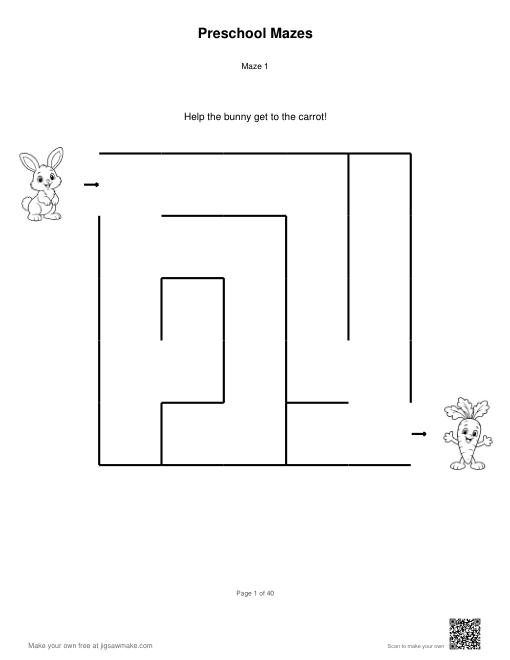
Use this guide to choose a first page, then adjust from what you observe. Browse the mazes for kids collections for illustrated and shaped puzzles. For ready-made rectangular sets across more difficulty levels, visit the printable maze generator.
Choose the Page by What the Child Does
Age can help you choose a first maze, but it cannot tell you how a particular child will respond to that page. Start by watching three things: can the child locate the entrance and exit, keep a finger or pencil inside a corridor, and return to a junction after a wrong turn? A comfortable activity leaves room to explore those actions without turning the sheet into a test.
A larger grid is not the only way to change difficulty. The printed corridor width, number of choices, shape of the outline, and amount of adult help all affect the experience. Change one of these at a time. For example, keep a familiar 10×10 grid but choose Easy instead of Kids, or keep the difficulty and print the maze larger. Neither age nor finishing speed needs to determine the next page.
Ages 3–4: Begin with a Visible Goal
For a child trying a maze for the first time, a small rectangular grid with pictures at both ends gives you a clear starting story. Point to the character and ask where it wants to go. Then locate the entrance arrow together. A finger trace can come before a pencil line; there is no need to introduce both route finding and careful drawing at exactly the same moment.
The preschool pack contains 20 puzzles: seven at 5×5, seven at 6×6, and six at 7×7. Each maze keeps its walls and dead ends intact, leaving one clear route to the goal. Its character-and-object pairs include a bunny and carrot, a puppy and bone, and a bee and flower. At actual size on US Letter paper, passages are at least 12 mm wide and walls are at least 2.5 pt thick. Printer scaling changes these physical measurements, so check the first sheet.
Ages 5–6: Keep the Grid Familiar
The kindergarten pack begins with ten 8×8 puzzles, followed by ten 10×10 puzzles. Each maze has one clear route to the goal, with dead ends to explore and retrace. This provides two grid sizes to try while keeping the page size and picture format familiar. The labels are suggestions for browsing, not milestones a child must reach by a particular birthday. Returning to a preschool page is a reasonable choice whenever it makes the activity more enjoyable.
Try a short conversation at each junction: which route might reach the goal, and what will we do if it ends? Let the child choose before offering help. When a line goes the wrong way, return along the same corridor to the previous choice. If repeated erasing becomes tiring, use a finger or another clean copy. Completing a smaller maze comfortably can be a better next step than struggling through the whole collection.
Ages 7–8: Add Choices Without Adding Pressure
The collection for 7–8 year olds contains 20 illustrated 14×14 mazes at Easy difficulty. It offers more cells than the kindergarten collection while keeping the same character-and-goal format. Before moving up, print one page and look at the passage width. A child may enjoy deciding where to turn but still prefer more room to draw; in that case, a larger printed grid is not automatically the right choice.
Use the answer page to prepare prompts rather than revealing the entire route. You might point out a junction worth revisiting or ask which corridor has already been explored. Keep timing optional. A child who spends time explaining a route has not failed because someone else finishes sooner. In a classroom, place a smaller-grid option beside the 14×14 sheet and let students choose without announcing ability groups.
Ages 9–10: Explore Shapes or a Custom Challenge
For children who already enjoy rectangular mazes, changing the outline can make the next puzzle interesting without inventing a new solving rule. The animal pack has ten Easy mazes on 40×40 grids, one per built-in animal. The geometric pack has twelve puzzles: four each in heart, star, and circle outlines. These still use horizontal and vertical passages. Blank space outside the silhouette is not a route to the exit.
A shape does not guarantee an easier or harder maze. A narrow part of a silhouette may offer fewer choices, while a broad body can contain more branching corridors. Print one at full page size and assess the actual result. For a rectangular challenge, use the custom generator to try a 15×15 or 20×20 grid and adjust the difficulty separately. These are options to explore, not prescribed settings for every nine- or ten-year-old.
Match the Pack to the Activity
A single illustrated page suits a quiet arrival activity because the entrance and goal can be introduced quickly. For partner work, let one child describe a possible turn while the other points to it, then swap roles. If both want to draw, provide separate copies. This keeps the discussion cooperative without asking two pencils to share a narrow passage or allowing one person to take over the sheet.
For a travel folder or home activity basket, choose a small selection instead of printing the entire pack automatically. Include a familiar page and one optional challenge, with the answers kept separately. At school, an early-finisher choice can include a rectangular maze and an animal outline. The choice itself is useful information about what a child wants to try; it does not need to become a score or a public ranking.
Print the Right Pages and Keep the Answers
All five children's packs use US Letter paper and one puzzle per page. Puzzle pages come first; numbered answer pages follow in the same order, with a red solution line. A 20-puzzle pack therefore has 40 pages. Select only the puzzle range in the print dialog when you want a student set. Keep the complete file so that a missing answer can be found later by its maze number.
On A4 paper, use the printer's fit option and inspect a test sheet for clipped edges. Scaling will change corridor widths, including the preschool pack's actual-size measurements. If you need a file designed for A4, choose A4 in the custom generator instead. That generator creates a new maze and does not add the ready-made packs' character pictures. Its puzzle PDF and answer-key PDF are separate downloads, so check the selected export before printing.
Change One Setting When the Page Feels Wrong
If a child cannot comfortably follow a corridor, first consider print size and the drawing tool. If the route is easy to see but every junction causes frustration, try fewer cells or Kids difficulty. If the puzzle is comfortable and the child asks for another challenge, change the grid, difficulty, or outline one at a time. Keep a successful sheet nearby as a reference for what worked, rather than comparing children with one another.
The custom generator on the children's page starts at 10×10 with Kids difficulty and a rectangular shape. Selecting an animal while either dimension is below 30 changes the grid to 30×30. For a circle, heart, or star, a dimension below 15 changes the grid to 20×20. This gives the outline more cells, but it also changes the tracing task. For very young beginners, keep the rectangle or use the illustrated preschool pack before introducing a detailed animal silhouette. Stop or switch activities when the child has had enough.
Frequently Asked Questions
What maze size should a three-year-old start with?
Try a small illustrated maze and trace it together with a finger. Our preschool collection begins at 5×5, but age alone does not determine a comfortable starting point. Watch whether the child can identify the goal and follow a corridor; offer help or another activity if the page feels frustrating.
Should a six-year-old use the kindergarten pack?
The kindergarten pack is one option, not a required level. It has ten 8×8 puzzles and ten 10×10 puzzles, each with one clear route to the goal. A six-year-old who wants more space can use the preschool pack, while a child who enjoys more choices can try a 14×14 page with support.
Are animal mazes easier than rectangular ones?
Not necessarily. The animal pack uses 40×40 grids, and the silhouette changes which cells are included. Some sections are narrow and others have more room for branches. Compare a printed sample with a familiar rectangular maze and choose based on the actual corridors, not just the animal picture.
How do I print without giving away the answers?
Print the puzzle section at the front of each pack and keep the answer section separately. Maze numbers match between the two sections. For example, a 20-puzzle pack has 20 puzzle pages followed by 20 answer pages. Preview your selected page range before sending a large job to the printer.
Can the custom generator add the animal-and-object pictures?
The character-and-goal pictures belong to the ready-made illustrated packs. The custom generator creates rectangular or shaped mazes without adding those paired pictures. Use it when you want different dimensions, difficulty, or a built-in outline; choose the packs when the illustrated starting story is the part you need.