Cryptogram Puzzles for Students: A Teacher's Guide
Learn how to use cryptogram puzzles in the classroom. Free cryptogram maker for teachers with grade-level activities, word lists, and lesson plan ideas.
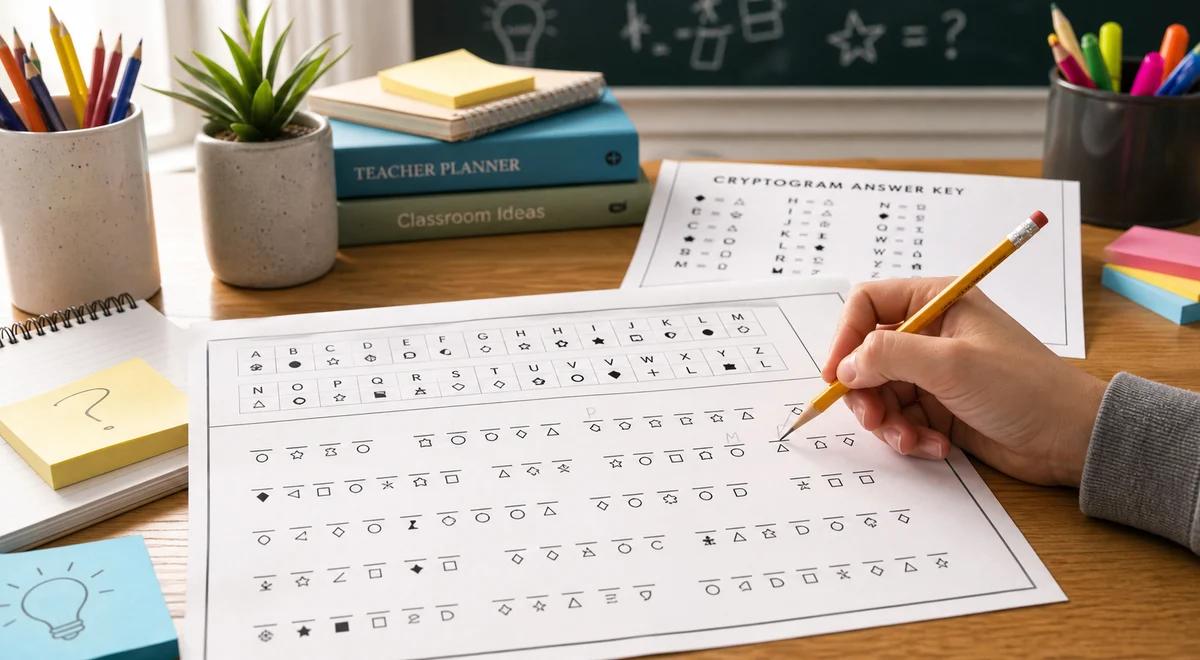
What Are Cryptogram Puzzles?
A cryptogram is a message that has been encoded using a simple substitution cipher. Every letter in the original text is replaced by a different letter according to a fixed key — for example, every A becomes Q, every B becomes X, every C becomes M, and so on throughout the entire message. The solver's job is to reverse-engineer the cipher and reveal the hidden phrase.
Here is a quick example. Take the sentence “Read more books.” After encoding, it might appear as “YLKC JXYL WXXQH.” The student notices that the three-letter word XYL could be the, are, or for, and works outward from there using pattern recognition and letter-frequency knowledge.
Unlike word searches — where the answer is always visible somewhere in the grid — a cryptogram gives students nothing but cipher text and their own reasoning skills. That distinctive feature is exactly what makes cryptogram puzzles for students so valuable in an academic setting.
Why Cryptograms Work for Learning
Research in cognitive science consistently shows that effortful retrieval produces stronger long-term memory than passive review. Cryptograms are effortful by design: every letter a student decodes requires active hypothesis-forming and testing. This is the core reason educational cryptograms outperform flashcards and fill-in-the-blank worksheets for retention.
Below are the specific academic skills that cryptogram activities build:
- Critical thinking and logical deduction: Students form theories about letter mappings, test them against the evidence in the puzzle, and revise when contradictions appear — the same reasoning loop used in scientific inquiry.
- Pattern recognition: Identifying high-frequency letters (E, T, A, O in English) and common short words (a, I, the, and, of) trains students to see structure in language.
- Spelling reinforcement: Decoding a word letter by letter burns its correct spelling into working memory more effectively than reading alone.
- Vocabulary exposure: Encoding a vocabulary list as cryptograms gives students a second meaningful encounter with each word beyond the initial definition.
- Persistence and frustration tolerance: Students learn that staying with a difficult problem — rather than giving up — eventually yields results. This metacognitive lesson transfers across subjects.
Cryptograms also differentiate themselves from crosswords and word searches in one critical way: they encode meaning, not just isolated words. A well-chosen quote or sentence means the student is also processing a complete idea while decoding — making the activity rich in language arts value at every grade level.
Cryptogram Activities for Language Arts
Language arts classrooms have the most natural fit for cryptogram activities because the encoded content can come directly from the curriculum. Here are proven formats teachers use every week:
Vocabulary Reinforcement Cryptograms
Encode a sentence that uses 3-5 current vocabulary words in context. When students decode the sentence, they encounter each word within a meaningful phrase rather than in isolation. For a unit on persuasive writing, for example, you might encode: “A compelling argument uses evidence to persuade the audience.” The decoding process guarantees that students see the words compelling, argument, evidence, and persuade spelled correctly — multiple times.
Author Quote Cryptograms
During a novel unit, encode a famous quote from the author or a key line from the text. After students decode it, the quote becomes a discussion prompt. This pairs especially well with Shakespeare, where students can decode a simplified modern paraphrase and then compare it to the original folio language. The contrast sharpens comprehension while the decoding activity drives engagement.
Grammar and Parts-of-Speech Cryptograms
Encode a sentence that contains specific grammatical structures you are teaching — prepositional phrases, relative clauses, or compound subjects. After decoding, students label the parts of speech or diagram the sentence. The two-stage activity (decode, then analyze) gives students ownership of the sentence before they dissect it.
Creative Writing Prompts
Encode the first line of a story and challenge students to continue the narrative after decoding. This combines puzzle-solving with creative writing in a single lesson block. Students who find blank-page writing intimidating often find it easier to start when the opening sentence is “given” to them through the puzzle.
Using Cryptograms for ESL and Vocabulary Building
Cryptogram puzzles for ESL students require a few adjustments, but the cognitive payoff is significant. The act of decoding forces letter-by-letter attention — which is precisely what language learners need to internalize spelling patterns in English.
For more ESL puzzle strategies that work alongside cryptograms, see our guide on ESL vocabulary activities.
Beginner ESL: Word-Bank Supported Cryptograms
Encode a 4-6 word phrase using only high-frequency vocabulary the class has already studied. Provide a word bank of 6-8 words (including the correct ones) printed below the cipher. Students use elimination alongside letter patterns to decode. This scaffold keeps the activity achievable while still delivering the cognitive engagement of true decoding.
Intermediate ESL: Sentence-Level Cryptograms
At B1-B2 level, students can decode full sentences without a word bank. Choose phrases that reinforce current grammar targets — simple past tense for a narrative unit, comparatives for a descriptive unit. After decoding, ask students to write one original sentence using the same grammatical structure. The cryptogram thus serves as both vocabulary input and grammar model.
Advanced ESL and Heritage Learners
Advanced learners can work with encoded proverbs, idioms, or content-area sentences from their subject classes. Encoding the same phrase in both English and the students' home language creates a bilingual cryptogram challenge that develops metalinguistic awareness — understanding how language itself works.
Grade-by-Grade Cryptogram Activities
The flexibility of substitution ciphers means cryptogram worksheets can be calibrated to almost any reading level. Below is a grade-band breakdown with recommended phrase length, hint level, and content type.
Elementary School (Grades 2–4)
- Phrase length: 3-5 words maximum
- Hint level: Provide 3 decoded letters as starting clues
- Sample content: Classroom rules, simple animal facts, seasonal phrases
- Sample phrase: “Books open new worlds.”
- Time: 10-15 minutes with teacher introduction
At this level, introduce the cipher concept as a “secret agent code” to maximize intrinsic motivation. Let students work in pairs so they can talk through their reasoning aloud.
Middle School (Grades 5–8)
- Phrase length: 8-15 words (a full sentence)
- Hint level: No hints, or provide only the most frequent letter (E)
- Sample content: Famous quotes, novel excerpts, historical facts, science definitions
- Sample phrase: “The only way to do great work is to love what you do.”
- Time: 15-25 minutes independently
Our Cryptogram for Middle School tool is pre-configured for this age range, with difficulty settings that match grades 5-8 reading levels. Pair completed cryptograms with a brief written reflection: what does the decoded quote mean to you?
High School (Grades 9–12)
- Phrase length: 15-25 words (a full sentence or two)
- Hint level: No hints; fully randomized cipher
- Sample content: Literary quotes, primary-source excerpts, AP vocabulary in context, philosophical statements
- Sample phrase: “That which does not kill us makes us stronger.” — Friedrich Nietzsche
- Time: 25-40 minutes; can be assigned as homework
High school students also respond well to timed cryptogram competitions. Project the same cipher for the whole class, set a 20-minute clock, and award a bonus point to the first three correct decoders. The competitive format drives engagement without requiring additional preparation from the teacher.
How to Create Cryptogram Worksheets
Creating a professional cryptogram worksheet used to require building a substitution cipher by hand — a tedious process that consumed planning time without adding instructional value. The free Cryptogram Maker on JigsawMake eliminates that friction entirely.
- Choose your phrase: Write or paste the sentence, quote, or vocabulary phrase you want to encode. Shorter is better for younger students; longer and more complex works for high school.
- Generate the cipher: The tool creates a randomized substitution cipher automatically. Each generation produces a unique cipher, so re-running gives you a fresh puzzle from the same phrase.
- Preview and adjust: Review the encoded output to confirm it looks appropriate for your grade level. Check that the encoded phrase does not accidentally create recognizable words that could give the answer away too easily.
- Download the PDF: The download includes both the student-facing puzzle sheet and a separate answer key, formatted for standard letter-size paper and ready to print.
For faith-based classrooms, the Bible Cryptogram Maker lets you encode Scripture verses directly. This is particularly effective for Sunday school, Christian school devotional time, or memory verse activities — decoding a verse is a far more active form of memorization than simply reading it.
If you also use crosswords and word searches in your class, the same workflow applies: our Crossword Maker for Teachers and Word Search Maker for Teachers follow an identical paste-and-download process. Many teachers create a three-puzzle activity set — word search for initial exposure, crossword for definition recall, cryptogram for synthesis — from the same vocabulary list in under 10 minutes.
Classroom Tips and Game Variations
A well-structured cryptogram activity is engaging on its own, but a few structural tweaks can transform it into a classroom event that students ask to repeat.
Collaborative Decoding (Teams of 3-4)
Assign one cipher to a team and let students divide the work: one tracks confirmed letter mappings on a shared chart, others test hypotheses on individual copies. The discussion that happens inside the team — “If that's E, then this three-letter word has to be THE —” mirrors scientific discourse and builds academic vocabulary around reasoning.
Relay Cryptogram
Print a longer cryptogram (20+ words) and cut it into strips of 4-5 words each. Each team member decodes their strip independently, then the group assembles the decoded strips in order to reveal the full message. The activity builds the same individual skills as solo decoding but adds an assembly challenge that tests the accuracy of each person's work.
Daily Warm-Up Cipher
Project a 5-8 word cryptogram on the board as students enter the room. Give them 5 minutes to decode before the lesson begins. Over a week, use the same cipher key but different phrases — students who recognized the pattern from Monday's puzzle will decode Friday's phrase in half the time, which provides a satisfying and measurable “aha” moment.
Cross-Subject Cryptograms
Cryptogram activities are not limited to language arts. Here are quick cross-curricular applications:
- Science: Encode a key definition or scientific law (“Matter can neither be created nor destroyed.”)
- History: Encode a primary-source quote or a key date and event
- Math: Encode a word problem (this adds a second layer of decoding — the cipher and then the math itself) — see also our guide on math puzzles for students
- Foreign Language: Encode a phrase in the target language to give students cipher-level exposure to correct spelling and diacritics
Differentiation Strategies
The same puzzle can serve multiple ability levels with small adjustments. For students who need support, print the cipher alphabet key with 3-4 letters pre-filled. For on-level students, provide no hints. For advanced students, give the cipher text only and ask them to also write two original sentences using the decoded vocabulary. This three-tier approach requires only one printout per activity rather than separate worksheets.
Cross-Puzzle Curriculum Units
For maximum vocabulary retention, combine puzzle types within a single unit. Start a vocabulary unit with a word search for initial visual exposure, move to a crossword for middle school for definition recall practice mid-unit, and close with a cryptogram that encodes each vocabulary word in a sentence for synthesis. The spaced repetition across three puzzle formats mirrors the exposure frequency research shows is necessary for long-term retention.
Frequently Asked Questions
What is a cryptogram puzzle?
A cryptogram is a word puzzle in which a message is encoded using a simple substitution cipher — each letter in the original text is consistently replaced by a different letter. Solvers decode the message by identifying letter patterns, common short words, and frequency clues.
What grade level is best for cryptogram puzzles?
Cryptograms can be adapted for grades 2 through 12. Younger students (grades 2–4) benefit from very short phrases with letter-frequency hints provided. Grades 5–8 can tackle full sentences without hints. High school students can work with longer quotes or sentences in a foreign language.
How long does a classroom cryptogram activity take?
Most single-sentence cryptograms take 5–15 minutes for students who are familiar with the format. Introducing the puzzle type for the first time usually requires 20–30 minutes including instruction.
Can I use cryptograms for ESL students?
Yes — with careful word selection. For ESL learners, encode short phrases made up of high-frequency vocabulary students already know. The decoding process gives them repeated exposure to correct spelling and word forms. Pair the cryptogram with a word bank for beginners.
How do I create a cryptogram worksheet?
Use the free Cryptogram Maker on JigsawMake. Type or paste your chosen phrase, sentence, or quote, then download a print-ready PDF that includes the encoded puzzle and a separate answer key.
Are cryptograms better than word searches for critical thinking?
Each puzzle type builds different skills. Word searches reinforce recognition and spelling. Crosswords train definition recall. Cryptograms uniquely develop logical deduction and systematic reasoning — students must form and test hypotheses with every letter they identify.
Can I make cryptograms with Bible verses?
Absolutely. The Bible Cryptogram Maker on JigsawMake is specifically designed for encoding Scripture verses and inspirational quotes. It works the same way as the standard Cryptogram Maker.
How do I differentiate cryptogram activities for different ability levels?
Three simple adjustments cover most classrooms: (1) phrase length — shorter for struggling learners, longer for advanced students; (2) hints — provide the decoded value of 2–3 high-frequency letters as a scaffold; (3) cipher complexity — for advanced students, use a fully randomized cipher with no hints.
Start Making Cryptogram Puzzles for Your Classroom
Cryptogram puzzles for students are one of the highest-value, lowest-prep activities a teacher can add to their toolkit. A single encoded sentence becomes 15-25 minutes of focused, self-directed critical thinking — all from a phrase you already had in your lesson plan.
The free Cryptogram Maker handles the cipher generation and PDF formatting so you can focus on choosing content that fits your curriculum. Whether you are encoding vocabulary words, novel quotes, historical facts, or Scripture verses, the workflow is the same: type, generate, download, print.
Ready to build your first cryptogram worksheet? Open the Cryptogram Maker →
Need more puzzle ideas for your classroom? Explore the Cryptogram for Middle School tool for grade-specific settings, or browse the full suite of teacher tools — including the Crossword Maker for Teachers and the Word Search Maker for Teachers — to build a complete puzzle-based curriculum resource library.