Word Scramble Activities for ESL & Vocabulary Building
Create word scramble activities for ESL classrooms and vocabulary lessons. Free word scramble maker with tips, word lists, and classroom game ideas.
What Are Word Scramble Activities?
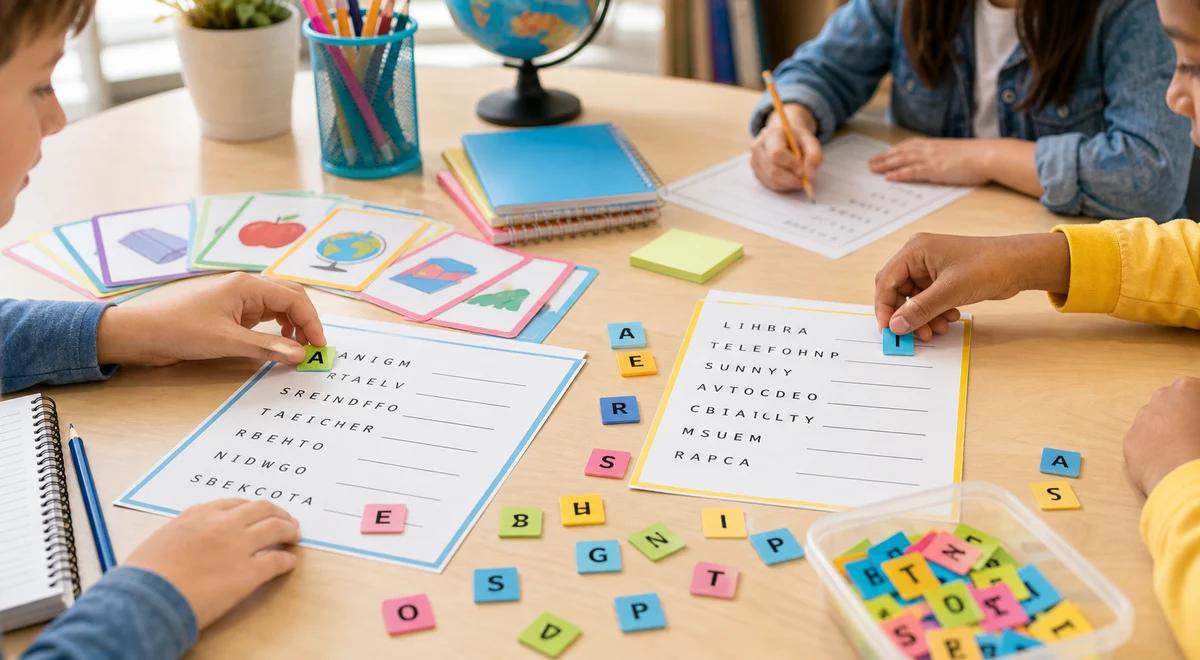
A word scramble is a puzzle where letters of a word are mixed up and presented in random order. Students study the jumbled letters, recognize the pattern, and rearrange them to spell the correct word. The activity sounds simple — and that's exactly why it works so well in language classrooms.
Word scrambles sit in a distinct category among vocabulary puzzles. A Word Search Maker for Teachers asks students to locate hidden words inside a letter grid — a useful reading exercise, but one that does not require students to recall the spelling from memory. A Crossword Maker for Teachers demands that students access a word from a definition clue, which is a higher-order retrieval task. Word scrambles occupy the middle ground: students already know the letters involved, so the cognitive load centers on spelling and letter-order recognition rather than recall.
That targeted focus makes word scramble activities for ESL learners especially valuable. English spelling rules are notoriously irregular, and non-native speakers benefit from repeated, low-stakes exposure to the visual form of words — exactly what scrambles provide.
Why Word Scrambles Work for Language Learning
Language acquisition research consistently shows that vocabulary retention improves when learners engage with a word through multiple modalities. Writing the word, seeing it in context, hearing it spoken, and manipulating its letters each add a separate memory trace. Word scramble activities for students tap into the orthographic processing pathway — the brain's ability to recognize and store the visual letter sequences that make up words.
Here is why vocabulary word scramble activities earn their place in effective ESL instruction:
- Spelling reinforcement: Students cannot complete a scramble without producing the correctly spelled word, which provides immediate, self-correcting feedback.
- Letter pattern recognition: Rearranging letters trains learners to notice common English patterns like consonant clusters, vowel combinations, and word endings (“-tion,” “-ing,” “-ness”).
- Low-anxiety practice: Because the letters are provided, scrambles feel less intimidating than open-ended spelling tests. This lowers the affective filter for anxious language learners.
- High engagement: The puzzle format turns vocabulary study into a game, increasing time-on-task and voluntary repetition.
- Independent work compatibility: Scramble worksheets require no special materials and work equally well as homework, warm-ups, or sub-plans.
Word Scramble Activities for ESL Classrooms
ESL teachers face a unique challenge: their students' literacy levels in their first language vary widely, as do their existing exposure to English. Word scramble activities for ESL classrooms are flexible enough to serve every profile.
Warm-Up Scrambles
Post five scrambled vocabulary words on the board as students arrive. Give them three minutes to write the unscrambled words in their notebooks before the lesson begins. This activates prior knowledge, settles the class, and gives you a quick informal assessment of retention from the previous session.
Picture-Clue Scrambles for True Beginners
Pair each scrambled word with a small illustration. A student who does not yet know the English word “umbrella” can use the picture to understand the target meaning before attempting to arrange the letters. This scaffolded version of the word scramble for students makes the activity genuinely accessible at CEFR A1–A2 levels.
Word-Bank Scrambles
Provide a reference word bank at the top of the worksheet. Students match each scrambled set of letters to a word from the bank. This variation shifts the cognitive demand from recall to recognition, which is appropriate for early-stage learners or newly introduced vocabulary.
Sentence-Context Scrambles
Include each scrambled word inside a sentence with a blank: “The weather today is very LDCO. (__ __ __ __)” This variation teaches vocabulary in context, reinforces reading comprehension, and makes the activity meaningful rather than purely mechanical.
Vocabulary Building with Word Scrambles
Vocabulary word scramble worksheets are most powerful when the word list aligns tightly with the current teaching unit. Rather than using generic vocabulary lists, build your scrambles around the specific terms students are expected to master this week.
Consider these high-value word list themes for ESL vocabulary building:
- Thematic units: Food, clothing, household items, transportation, and occupations all generate word lists that connect directly to communicative practice students will do in the same lesson.
- Academic word list (AWL): For intermediate and advanced ESL students preparing for academic study, scrambles built from AWL sublist words (analyze, contrast, significant, identify) reinforce terms that appear across content areas.
- Collocations and word families: Group scrambles by word families (happy / happiness / unhappy) so students notice morphological patterns as they unscramble.
- Content-area vocabulary: Science, social studies, and math classrooms with ELL students benefit enormously from subject-specific scrambles that reinforce terms students encounter in textbooks.
If you also use vocabulary-based crosswords in your classroom, the Vocabulary Crossword Maker lets you build definition-based puzzles from the same word list — giving students two different cognitive encounters with the same target vocabulary in one unit.
Word Scramble Games by Skill Level
Differentiation is the core challenge of multilevel ESL classes. Word scramble activities are easy to differentiate because you simply adjust the word length and list complexity while keeping the activity format identical for everyone.
Beginner Level (CEFR A1–A2)
Focus on high-frequency, short words that students encounter every day. Keep word length to 3–5 letters to limit cognitive load while still delivering spelling practice.
- Colors: DRE (red), LBEU (blue), GEREN (green)
- Numbers: OWN (one), OWT (two), HVIE (five)
- Animals: TAC (cat), ODG (dog), SIHF (fish), DBRI (bird)
- Body parts: MRA (arm), EEY (eye), NOSE (nose), ADER (ear)
Intermediate Level (CEFR B1)
Move to topic vocabulary students need for everyday communication, using 6–8 letter words with slightly more complex spelling patterns.
- Daily routines: KABREFAST (breakfast), WSOHER (shower), CLSOHCHE (schedule)
- Weather: DNYIW (windy), DOLYCSU (cloudy), GHTUHNRE (thunders)
- Travel: GAALUGG (luggage), RAOTPRI (airport), EICCKT (ticket)
Advanced Level (CEFR B2–C1)
Use academic vocabulary list words, content-area terms, and longer multi-syllable words where correct spelling is essential for written academic work.
- Academic verbs: EZAYLNA (analyze), TASECLU (discuss → USSSDIC), YTAECVLD (validate)
- Science: OSAHIBTNS (obtaining), IPESCSH (species), OTIEULONS (solutions)
- Transition words: RRHOFMTHREE (furthermore), NRSTRCAT (contrast), LSECRNTEEHY (consequently)
How to Create Word Scramble Worksheets
Creating a custom word scramble worksheet by hand takes time — you need to manually shuffle letters, lay out the page, and separately prepare an answer key. An online word scramble maker removes all of that friction and produces a print-ready worksheet in under a minute.
Here is the process using our Word Scramble Maker:
- Paste your word list. Type or paste each target vocabulary word, one per line. The tool accepts any English words.
- Choose your scramble settings. Select whether you want purely random letter order or a scramble that preserves the first letter as a hint — useful for beginners.
- Add a title and instructions. Customize the worksheet header with your class name, unit title, or specific instructions (e.g., “Unscramble each word and write it on the line”).
- Preview and download. The generator instantly displays a formatted worksheet. Download the PDF, print it, and distribute — the answer key is included on a separate page.
For classes that also need sight-word practice at the early reading level, the Sight Word Search Maker generates word-search grids from Dolch and Fry sight word lists — a complementary activity to use alongside scrambles for foundational literacy learners.
If you want to expand your classroom puzzle toolkit, our guide to printable puzzles for the classroom covers how to pair different puzzle types across a unit for maximum vocabulary retention.
Classroom Games and Activity Variations
Word scramble for students does not have to mean silent, individual worksheet work. The format adapts easily to collaborative, competitive, and kinesthetic variations that raise energy and deepen engagement.
Timed Challenge
Display a scrambled word on the projector. Set a 30-second timer. Students write the answer on whiteboards or slips of paper and hold them up simultaneously. This formats the activity as a whole-class game while giving every student equal think time — no fast-finisher calling out answers before others have a chance to process.
Team Relay Race
Divide the class into teams of four. Post ten scrambled words on the board. Each team member takes turns running to the board, unscrambling one word, and writing the answer before tagging the next teammate. The first team to correctly unscramble all ten words wins. This variation adds movement and peer accountability.
Letter Tile Scramble (Hands-On)
Write individual letters on index cards or squares of paper. Hand each small group a set of cards representing one scrambled word. Groups physically arrange the cards until they form the correct word. Kinesthetic learners particularly benefit from manipulating physical letters rather than writing on a worksheet.
Partner Dictation Scramble
Partner A looks at the answer key and reads aloud the correctly spelled word while Partner B writes the letters down — intentionally scrambled — then both partners attempt to unscramble Partner B's version. This reversal of the activity reinforces both spelling and listening skills simultaneously.
Digital Scramble with Instant Feedback
For 1:1 device classrooms, assign students to complete a digital word unscramble activity. Immediate right/wrong feedback accelerates the correction cycle compared to waiting for teacher review of paper worksheets. Combine digital scrambles with a class discussion of tricky words once students finish.
For additional activity ideas that complement word scrambles, explore our collection of ESL vocabulary word search activities — pairing word searches with scrambles in the same unit gives students two distinct encounters with the same vocabulary in one class period.
Frequently Asked Questions
What is a word scramble activity?
A word scramble presents students with a set of jumbled letters that they must rearrange to form a correctly spelled word. Unlike word searches or crosswords, word scrambles focus purely on letter recognition and spelling.
Are word scramble activities effective for ESL learners?
Yes. Research supports word-form activities like scrambles because they train learners to recognize letter patterns, reinforce correct spelling, and strengthen the connection between a word's visual form and its meaning.
What vocabulary level should I use for ESL word scrambles?
Match the word list to your students' proficiency level. Beginners benefit from short, high-frequency words (3–5 letters). Intermediate learners can tackle daily-routine verbs and weather vocabulary. Advanced students are ready for academic word list items.
How long should a word scramble worksheet take?
A 10–15 word scramble typically takes 10–15 minutes as a warm-up or exit ticket. Longer worksheets of 20–25 words work well as a full 20–30 minute independent activity.
Can I use word scrambles for content-area vocabulary?
Absolutely. Science teachers use them for biology and chemistry terms; social studies teachers scramble geography and civics words; math teachers target academic language. Any subject with key terminology benefits from scramble-based reinforcement.
How do I create a word scramble worksheet quickly?
Use our free Word Scramble Maker. Enter your word list, choose settings, and the tool generates a print-ready worksheet with an answer key in seconds.
What is the difference between a word scramble and a word unscramble?
The terms are used interchangeably. Both refer to the same activity: students receive jumbled letters and must identify the correct word. “Unscramble” emphasizes the student's action, while “word scramble” describes the puzzle format.
Can beginners with very limited English complete word scrambles?
Yes, with scaffolding. Add a picture clue beside each scrambled word so students know the target meaning before attempting the spelling. You can also provide a word bank so students choose from a known set rather than recalling from memory.
Create Your Word Scramble Activity Today
Word scramble activities are one of the most efficient vocabulary tools available to ESL and language arts teachers. They take minutes to create, require no special materials to use, and deliver measurable spelling and vocabulary gains across all proficiency levels. Whether you build a quick five-word warm-up or a full-period differentiated worksheet set, scrambles earn their place in any vocabulary-focused lesson plan.
Use our free Word Scramble Maker to generate a custom, print-ready worksheet from your own vocabulary list in under a minute. Pair it with a Vocabulary Crossword Maker for definition-based practice, or add a Word Search Maker for Teachers for a complete three-puzzle vocabulary unit your students will actually enjoy completing.